Singers of all skill levels are welcome, and whether you have a lot of experience or none at all, you may find the shape-note singing tradition to be curious, exciting, and wonderful. Our monthly singings are informal and participation is easy and questions welcome.
Beginner Guide
fasola.org/resources/Grayson_Beginners_Guide_2024.pdf (download link)
Lisa Grayson publishes an excellent guide to hand out to newcomers at singing events.
It contains a list of frequently-asked questions, overview of shape-note history and musical background, and a visual guide to how a tune is laid out on the page.
Shape-note singing is an American a capella choral tradition with roots that stretch back into the 18th century. We sing four-part harmony, printed with shaped note heads that are designed to help with sight-reading.
Characterized by open harmonies and a raw, powerful sound, these tunes speak of death and love and powerful forces. Although shape note music is rooted in Christian hymnody, all religious affiliations (and non-affiliations) are welcome to join us. We sing for each other and the joy of singing. There is no audience and no director. This music designed for participation rather than performance.
Below are a few quick immediate differences you’ll want to know about when you show up.
Shape Notes
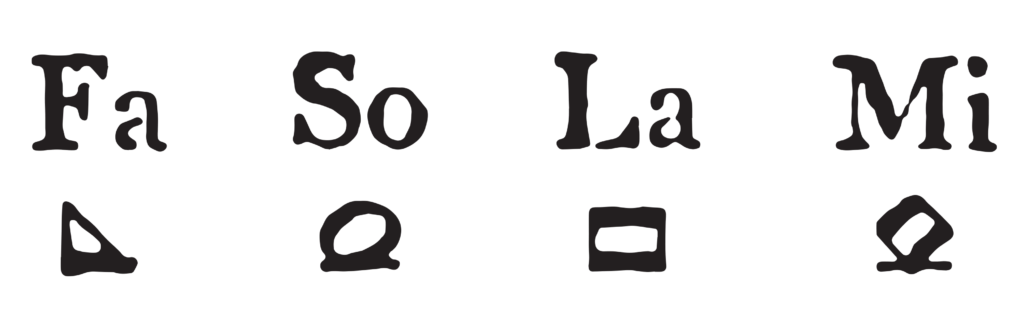
The music in The Sacred Harp and Shenandoah Harmony books are written in standard notation, except that the note heads appear in four different shapes; therefore the music is also called “Shape-Note” or “Shaped-Note”. This four-note system is used to teach sight-reading to people without musical training. Our tunebooks use the old four-note English system: fa, sol, la, fa, sol, la, mi, fa. (Compare to the newer solfège system of do, re, mi, fa, sol, la, ti, do.)
With our shape-note system, there’s no need to worry about different keys, so all tunes are in relative pitch instead of absolute. Before singing the words to a shape-note tune, we “sing the shapes” by singing the syllables fa, so, la, and mi to try to learn our parts before tackling the words.
(And yes, for newer singers, it’s perfectly acceptable to sing “la la la” or “fla fla fla” until you get the hang of it!)
The Four Parts of the Tune
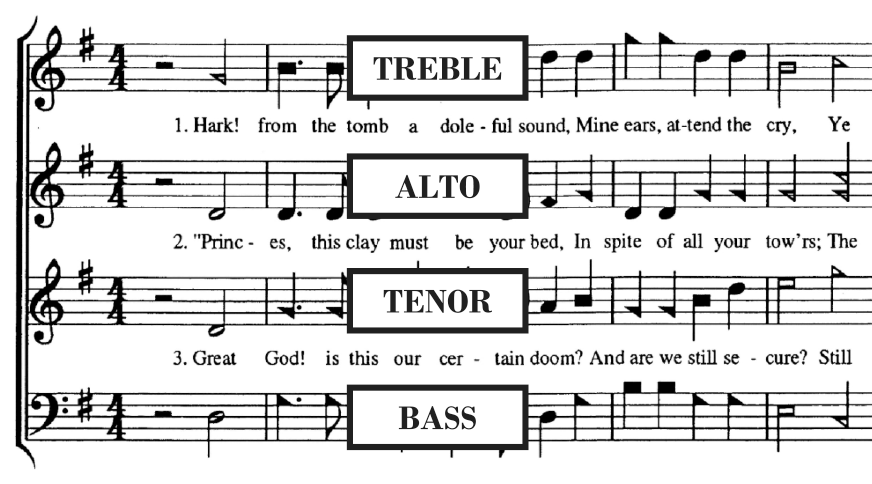
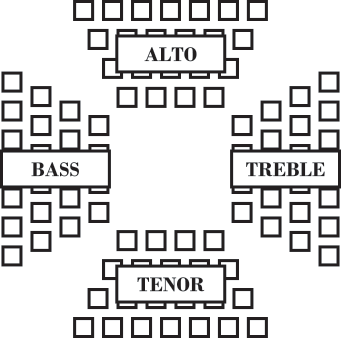
Shape-note music is divided into four parts: treble, alto, tenor, and bass. These generally track to the SATB parts of mainstream choral music, but depending upon inclinations of temperament, timbre, or necessity, the treble and tenor parts are usually sung in both high and low octaves by participants. The four parts sit in a “hollow square” as in the diagram above, since the intended listeners for this music is ourselves and not a distant audience. When someone stands in the middle to lead a song, they will usually face the tenor section.
New singers are often advised to sing tenor, because that’s usually where the “melody” is. But feel free to move around to different parts to see what feels comfortable to you.
Why are people moving their arms up and down?
This is one of the most baffling aspects of shape-note singing for newcomers. The hand and arm motions are a traditional way of keeping time. When a person stands in the middle of the square to lead, they move their arm to indicate the tempo: down for the 1 and 2 beats, up for the 3 and 4. (This varies in different time signatures.) The other singers, especially those in the front row of larger singings, will join these movements because it helps them keep the rhythm – and it can be fun, too.
Why is everyone singing at the top of their lungs?
This is one of the deepest joys of our musical tradition! If you have some musical background, you will notice that there are very few markings in our books to indicate loudness or softness. Shape-note is a participatory, immersive practice; in other words, loud is good, and louder is better. Feeling your whole chest vibrate as you sing in harmony with others is a transcendent experience!
There is so much more to learn, but questions are always encouraged, and new people are always welcome. Come join us!
 Richmond Shape Note Singers